1.8. Syllables ✅
1.8.1. What Is a Syllable?
A syllable is a unit of organization for sequences of speech sound.
There are two types of syllables:
- Open syllable: A syllable that ends in a vowel (ex: "si")
- Closed syllable: A syllable that ends in a consonant (ex: "con")
Furthermore, a syllable consists of three elements:
- Onset: The initial consonant sound or sounds that go before the nucleus.
- Nucleus: The central, most prominent part of a syllable. It contains a vowel or combination of vowels (diphthong or triphtong). It is the only obligatory part of a syllable.
- Coda: The final consonant sound or sounds that follow the nucleus.
Read below for the rules that decide syllables in Neolatin.
1.8.2. Rules for Syllabification
1. Consonant Between Two Vowels (Simple Consonant)
A simple consonant in front of a vowel accompanies the vowel that follows it.
| Word | Syllabification | Narrow IPA Transcription |
|---|---|---|
| Amo | a.mo | [ˈa.mo] |
| Casa | ca.sa | [ˈka.sa] |
| Tèma | tè.ma | [ˈt̪ɛ.ma] |
| Banana | ba.na.na | [baˈna.na] |
2. Two Consonants Between Vowels
a. Unbreakable Consonant Clusters
The combinations of consonants below must belong to the same syllable.
i. Bilabial or Labiodental Consonants With a Liquid Consonant: (<b, f, p, v>) + (<l, r>)
| Graphic Representation | IPA Transcription | Example | Syllabification | Narrow IPA Transcription |
|---|---|---|---|---|
<bl> | /bl/ | Oblitare | o.bli.ta.re | [o.bliˈt̪a.ɾe] |
<br> | /bɾ/ | Zebra | ze.bra | [ˈze.bɾa] / [ˈʣe.bɾa] |
<pl> | /pl/ | Plato | pla.to | [ˈpla.t̪o] |
<pr> | /pɾ/ | Aprire | a.pri.re | [aˈpɾi.ɾe] |
<fl> | /fl/ | Flore | flo.re | [ˈflo.ɾe] |
<vl> | /vl/ | Vladimir | vla.di.mir | [vla.d̪iˈmiɾ] |
<vr> | /vɾ/ | Havría | a.vrí.a | [aˈvri.a] |
ii. Velar Consonant With a Liquid Consonant: (<g, c>) + (<l, r>)
| Graphic Representation | IPA Transcription | Example | Syllabification | Narrow IPA Transcription |
|---|---|---|---|---|
<gl> | /gl/ | Globo | glo.bo | [ˈglo.bo] |
<gr> | /gɾ/ | Grado | gra.do | ['gra.d̪o] |
<cl> | /kl/ | Clamare | cla.ma.re | [klaˈma.ɾe] |
<cr> | /kɾ/ | Crédere | cré.de.re | [ˈkre.d̪e.ɾe] |
iii. Dental Consonant With Alveolar Flap: (<dr>, <tr>)
| Graphic Representation | IPA Transcription | Example | Syllabification | Narrow IPA Transcription |
|---|---|---|---|---|
<dr> | /dɾ/ | Dragone | dra.go.ne | [d̪raˈgo.ne] |
<tr> | /tɾ/ | Matre | ma.tre | [ˈma.t̪ɾe] |
b. Geminates
The first consonant of the geminated sequence goes at the end of the first syllable, while the second consonant goes at the start of the second syllable.
| Word | Syllabification | Narrow IPA Transcription |
|---|---|---|
| Vacca | vac.ca | [ˈvak.ka] |
| Gruppo | grup.po | ['gɾup.po] |
| Differènte | dif.fe.rèn.te | [dif.fe.ɾen̪.t̪e] |
| Interessante | in.te.res.san.te | [in̪.t̪e.ɾes'san̪.t̪e] |
c. Exception: Digraphs (ex: <ch, gh, rr>)
Digraphs represent one phoneme graphically. Therefore, they cannot be separated into separate syllables.
| Word | Syllabification | Narrow IPA Transcription |
|---|---|---|
| Tèrra | tè.rra | [ˈt̪ɛ.ra] |
| Màchina | mà.chi.na | [ˈma.ki.na] |
d. Groups of Consonants Not Allowed at the Start of a Word
In the cases of sequences that cannot exist at the start of a word (ex: "nt"), the first consonant goes with the first vowel and the second consonant goes with the second vowel.
| Word | Syllabification | Narrow IPA Transcription |
|---|---|---|
| Artista | ar.tis.ta | [aɾˈt̪is.t̪a] |
| Cònto | còn.to | [ˈkɔn̪.t̪o] |
| Facto | fac.to | [ˈfak.t̪o] |
| Cerca | cer.ca | [ˈʧeɾ.ka] |
3. Three or More Consonants Between Two Vowels
The first consonant usually stays with the preceding vowel and the next two form a syllable with the next vowel.
| Word | Syllabification | Narrow IPA Transcription |
|---|---|---|
| Anglese | an.gle.se | [an̪ˈgle.se] |
| Còntra | còn.tra | [ˈkɔn̪.t̪ɾa] |
| Englobare | en.glo.ba.re | [en̪.gloˈba.ɾe] |
4. Hiatus: Two Strong Vowels Belong to Two Different Syllables
| Word | Syllabification | Narrow IPA Transcription |
|---|---|---|
| Día | dí.a | [ˈd̪i.a] |
| Vehículo | ve.hí.cu.lo | [veˈi.ku.lo] |
| Leone | le.o.ne | [leˈo.ne] |
| Continuum | con.ti.nu.um | [kon̪ˈt̪i.nu.um] |
5. Diphthongs Belong to the Same Syllable
| Word | Syllabification | Narrow IPA Transcription |
|---|---|---|
| Mais | mais | [ˈmajs] |
| Guida | gui.da | [ˈɡwi.d̪a] |
| Piano | pia.no | [ˈpja.no] |
6. Triphthongs Belong to the Same Syllable
| Word | Syllabification | Narrow IPA Transcription |
|---|---|---|
| Cambiai | cam.biai | [kamˈbjaj] |
| Miau | miau | [ˈmjau] |
7. Special Case: S + Consonant(s)
If a consonant cluster consisting of S and one or more consonants is in the middle of a word, the S may join the first syllable or stay with the consonant in the second syllable.
| Word | Syllabification | Narrow IPA Transcription |
|---|---|---|
| Basta | bas.ta / ba.sta | [ˈbas.t̪a] / [ˈba.st̪a] |
| Mostrare | mos.tra.re / mo.stra.re | [mosˈt̪ɾa.ɾe] / [moˈst̪ɾa.ɾe] |
| Còsta | cos.ta / co.sta | [ˈkɔs.t̪a] / [ˈkɔ.st̪a] |
1.8.3. Epenthesis?
Epenthesis is the addition of one or more sounds to a word. The most common type of epenthesis is prothesis, which is the addition of a sound in the first syllable of a word.
For example, Romance languages of Iberia (Portuguese, Spanish, Catalan) and Occitan place an “E” before a consonant cluster that starts with an S. For example, Sprite is pronounced as [es.pɾajt]. This is because the onset of a syllable in these languages, no matter if the syllable is the first syllable of a word or inside the word, does not allow consonant clusters of consonants starting with “S”, like “st”, “str” and “spl”, even though these consonant clusters existed in Latin.
As a comparison between modern Romance languages, Romance languages of Iberia and Occitan, except for recent borrowings, always place an “E” at the beginning of a word, regardless if the word was inherited or borrowed.
French shows prothesis for inherited words (ex: école) and lacks it for borrowed words (ex: sclérose). Italian tends to eliminate vowels or consonants at the beginning of a word, resulting in consonant clusters that sometimes did not exist in Latin. This is seen in words that had the prefix “ex” or “dis”, like in the word "sfruttare".
However, it is interesting to note that even Italian evolved prothesis before it was lost. For example, "iscritto" instead of modern Italian "scritto". That being said, modern Italian contains vestiges of prothesis in certain set phrases where the word before ends in a consonant, like "per iscritto".
Brazilian Portuguese shows different applications of epenthesis. Brazilian Portuguese sometimes demonstrates epenthesis in the middle of a word (ex: "hipnose", [i.piˈnɔ.zi]. Similarly, in spoken Italian, one may hear the word “aritmetica” as “aritimetica” [a.ɾi.tiˈmeːti.ka]. Brazilian Portuguese also has paragoge, which is epenthesis at the end of a word (ex: "pop", [ˈpɔ.pi]). An example of more than one type of epenthesis is the word “swing”, which is pronounced as [sʊˈĩ.ɡi], which has both prothesis and paragoge.
In Neolatin, prothesis (epenthesis at the beginning of a word) is seen in inherited words (ex: "escòla", "estare", "esperare", "estella").
In contrast, words borrowed from Latin lack the extra vowel (ex: "splèndido", "sclerose", "stellare").
This also results in doublets, where each word, depending on its origin as an inherited word or a loanword, has a different meaning.
| Word | Meaning |
|---|---|
| Estato | The condition of something |
| Stato | The political entity |
| Status | Status |
In Neolatin, a consonant cluster containing "S" and another consonant is phonologically possible in the onset of a syllable. Because of this, the syllabification of "S" with the accompanying consonant or separate from it are both possible options in the middle of a word.
At the beginning of a word, in such a cluster, the spelling is mandatory. Optionally, it is possible to pronounce it with prothesis, inserting an "E" at the beginning of the word.
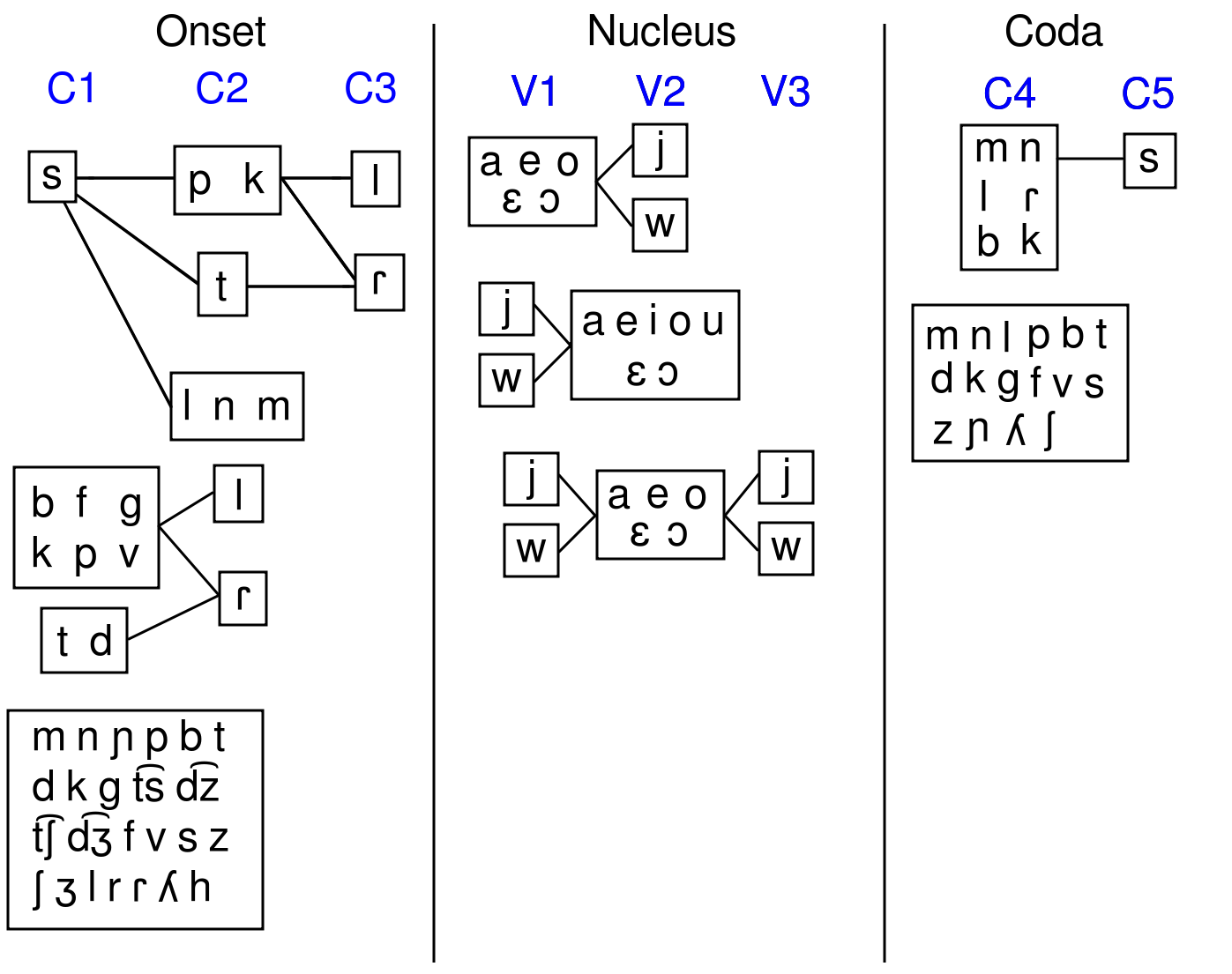
1.8.4. Phonotactics
Onset
Nucleus
Coda
Phonotactics is the study of the ways in which phonemes are allowed to combine in a particular language; in other words, the order of sounds that is possible.
Below is a graphical representation of Neolatin's permissible phonotactics.